Smart Search System with AI-assisted Query Understanding
Product team
1 backend engineer
1 frontend engineer
QA support during tuning phase
Duration: 6 months
Technologies

Laravel

PostgreSQL

Redis

Blade / HTML

Alpine.js

OpenAI API
Production Context
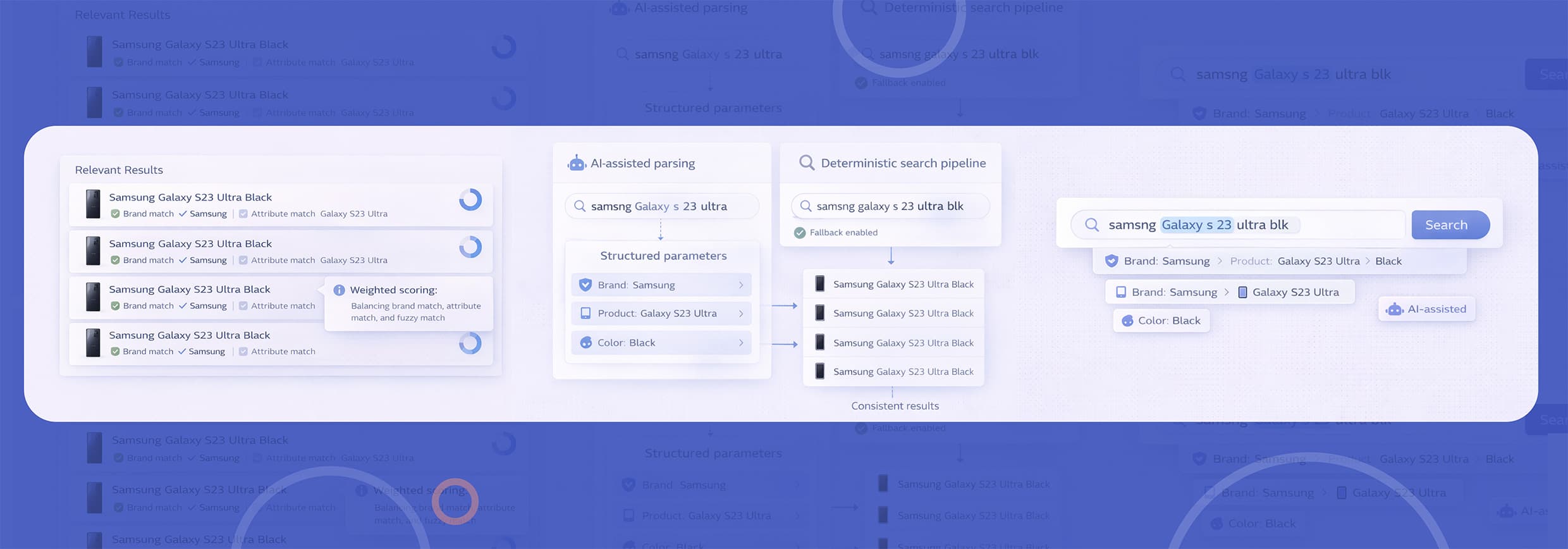
The project focused on building a smart search system capable of handling real-world free-text queries across large product catalogs.
Unlike simple keyword-based search, the system needed to process noisy input, including typos, fuzzy matches, transliteration, synonyms, and mixed-language queries, while maintaining fast response times and stable relevance.
The system was designed for large, evolving product catalogs where search accuracy directly impacts conversion, user trust, and operational efficiency. Incorrect brand detection or unstable relevance ranking could result in poor discovery, lost revenue, or increased manual intervention from support teams.
The Challenge
The main challenge was achieving accurate and predictable search results under imperfect input conditions without sacrificing performance or stability.
A critical requirement was ensuring that AI-assisted components could enhance relevance without introducing non-deterministic behavior, latency spikes, or system-level failures.
Our Role
We were responsible for the design and implementation of the search architecture, including relevance modeling, brand detection logic, AI-assisted query processing, performance optimization, and UI integration.
The Solution
Classical search techniques form the deterministic core of the system, handling normalization, tokenization, fuzzy matching, synonym expansion, and transliteration.
AI-assisted parsing is applied selectively to enrich queries with structured intent only when it improves relevance, while strict validation and fallback mechanisms preserve predictable behavior.
Key Capabilities
- Advanced free-text query processing with fuzzy matching and normalization
- Accurate brand detection across typos, split tokens, and mixed-language queries
- AI-assisted query structuring with strict validation and rate control
- Deterministic fallback logic ensuring stable behavior without AI
- Custom weighted scoring and relevance ranking
- High-performance execution with optimized indexes and caching
- Interactive, server-rendered search UI
The Process
Search behavior analysis
Real user queries were analyzed to identify common typo patterns, brand-related edge cases, and acceptable relevance trade-offs. This analysis shaped the balance between recall and precision and defined where deterministic logic was required.
Search architecture & scoring model
A layered search pipeline was designed to separate deterministic matching from optional AI-assisted enrichment. This approach allowed relevance improvements without introducing non-deterministic behavior or unstable scoring outcomes.
Development & AI integration
The core search logic was implemented with modular normalization and matching layers. AI-assisted parsing was added selectively, with strict output validation and fallback paths to ensure the system remained fully functional without AI.
Optimization & stabilization
Performance tuning focused on indexing strategies, caching, and minimizing expensive operations to maintain consistent response times under production load and large catalogs.
Result
The result is a production-ready smart search system that delivers high-quality, relevant results under real-world query conditions while maintaining predictable behavior, stability, and performance at scale.

Start creating something
exceptional together!
More recent Case Studies
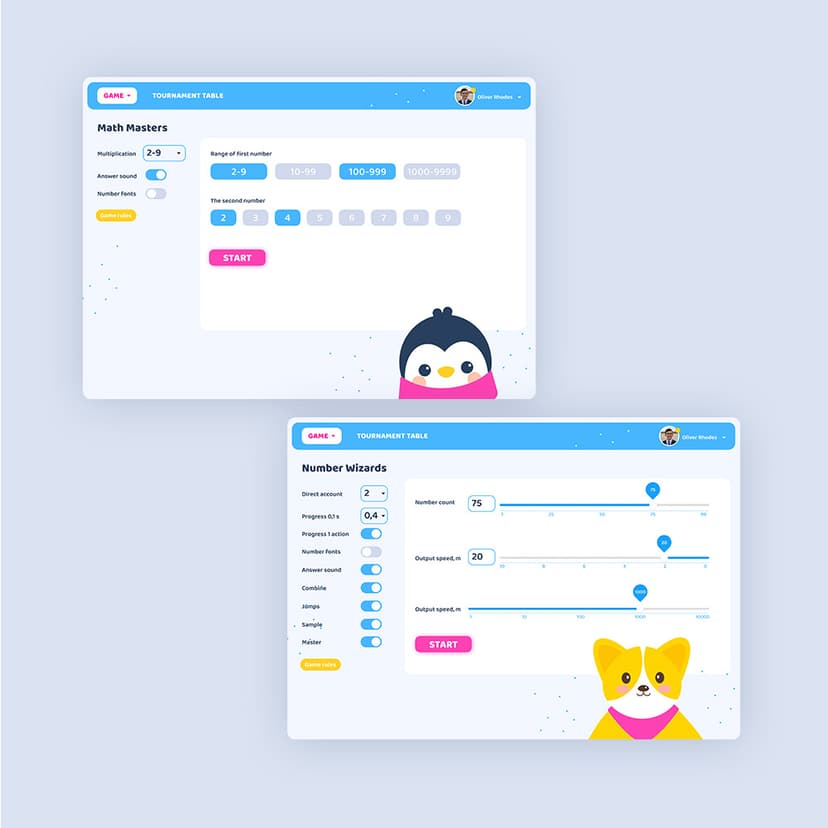
Seamless LMS platform for interactive math education
A multi-tenant LMS platform for interactive arithmetic education that combines engaging, child-friendly learning experiences with structured learning flows and progress tracking. The system provides educational organizations with the tools to manage courses, classes, and users while maintaining full administrative control across multiple organizations.

Booking & E-commerce platform for beauty service providers
A booking and e-commerce platform built for real-world beauty service operations, combining reliable appointment scheduling with integrated product sales. The system ensures consistent availability, structured booking flows, and operational control while delivering a fast, mobile-friendly experience for clients.
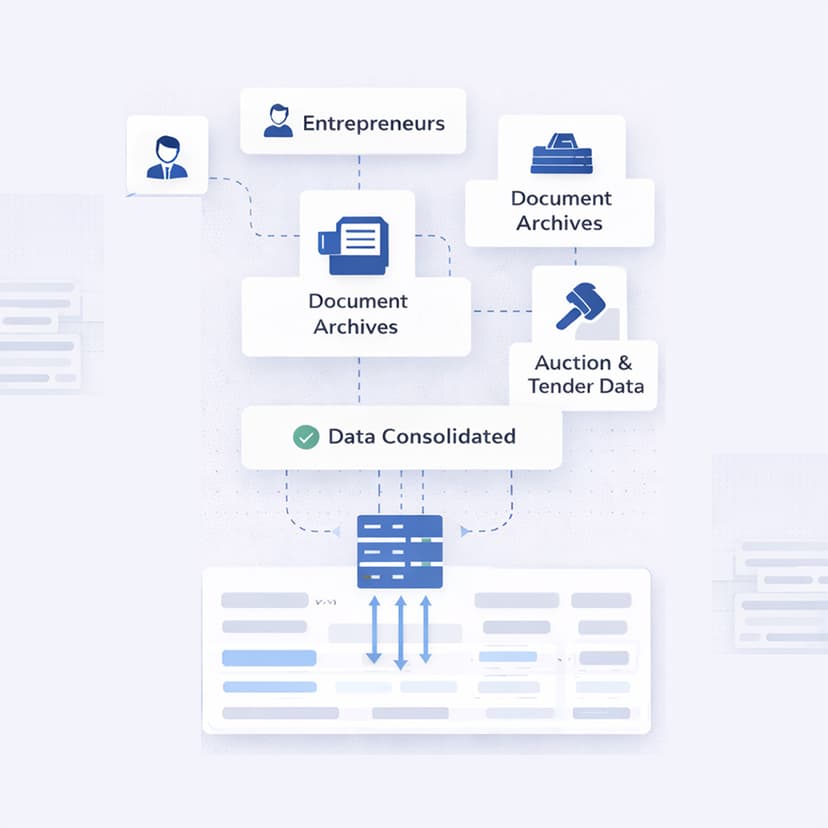
Open Data Aggregation Service for Entrepreneurs, Legal Entities & Tenders
An open data aggregation service that consolidates multiple public registries into a unified, searchable platform. The system normalizes heterogeneous datasets, preserves data provenance and update history, and enables reliable cross-linking between entrepreneurs, legal entities, and related tenders.
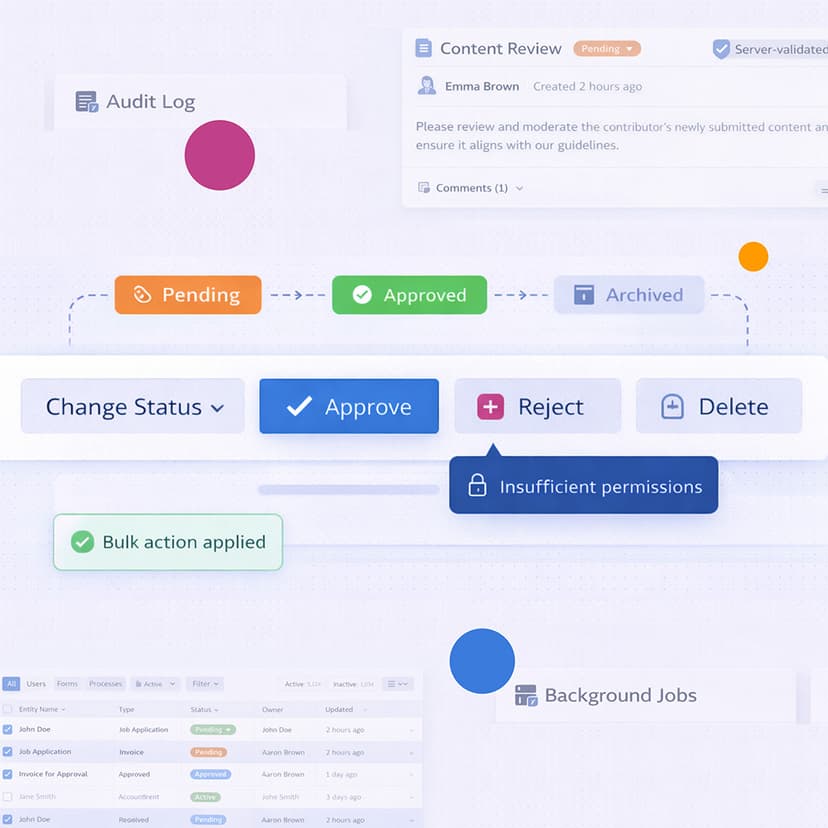
Admin Panels & Backoffice Suite for Internal Operations
A permission-driven admin and backoffice suite built for high-risk internal operations, where control, safety, and auditability are critical. The system enforces business rules server-side, supports role-based workflows, and provides clear visibility into actions, statuses, and execution history.
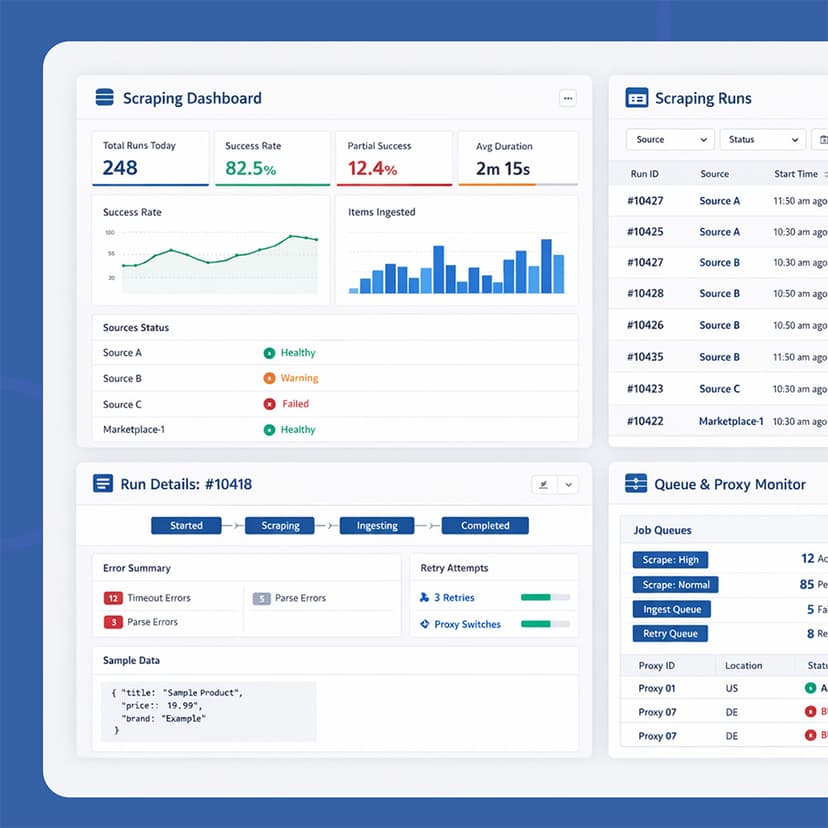
Retail Scraping & Ingestion System for E-commerce Data Collection
The system is designed for reliable extraction and ingestion of e-commerce product and promotional data. It supports multiple pagination strategies, operates through a managed proxy pool, and ensures stable data collection at scale. The goal is to provide consistent, observable, and fault-tolerant retail data pipelines.
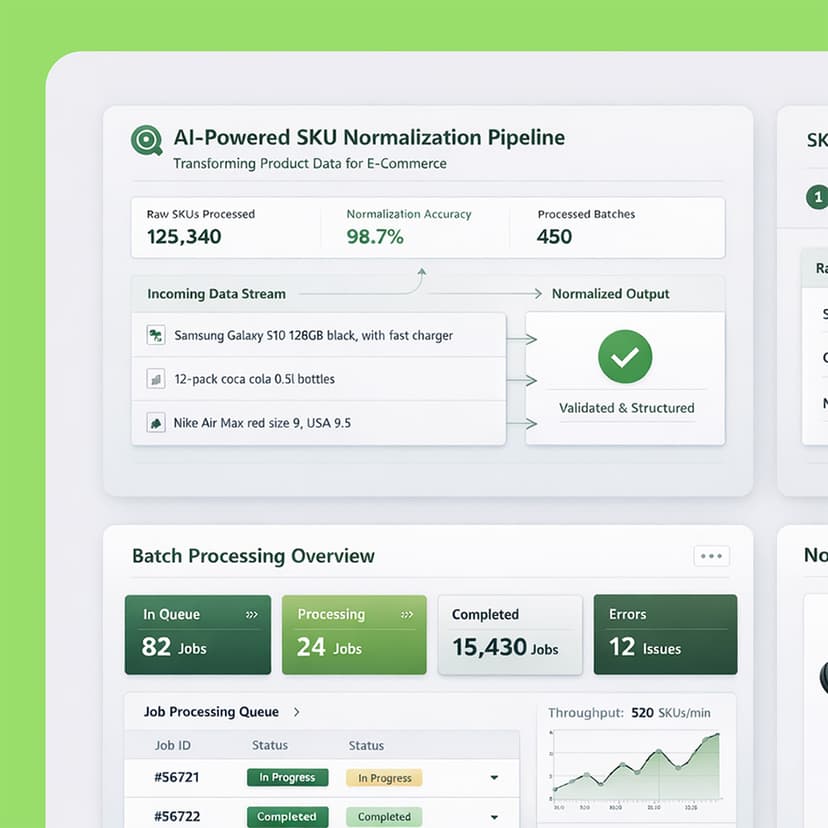
AI-powered SKU Normalization Pipeline for E-commerce Operations
The platform is designed to automatically normalize and standardize product data at scale. It transforms raw, inconsistent SKU titles and attributes into structured, high-quality product information, ensuring consistency across catalogs. The goal is to improve data accuracy, search relevance, and operational efficiency for e-commerce systems.
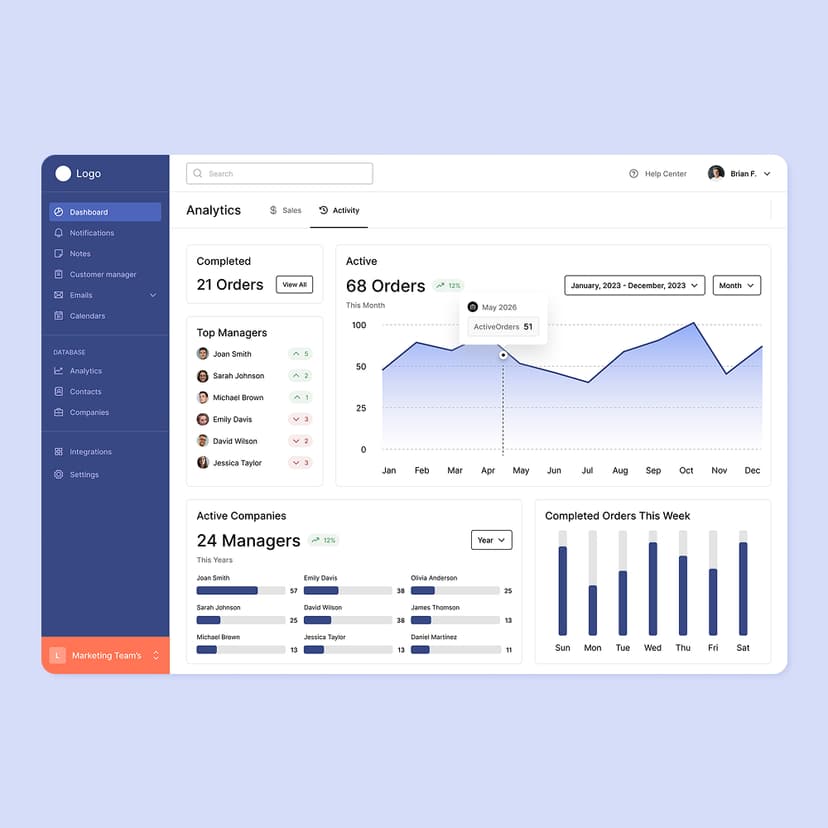
Custom SaaS CRM for E-commerce Operations
A custom SaaS CRM platform built for centralized order management, operational automation, and fulfillment workflows. The system integrates with WordPress-based e-commerce websites, synchronizes incoming orders, and helps operational teams manage the full order lifecycle from creation to shipment within a single platform.